
Read the signs before you calculate
Math 123 uses only ones, twos and threes, added or taken away. Every dealt sum has an answer of 1, 2 or 3. The challenge is keeping the signs straight while the questions get longer and the time gets shorter.
Begin by reading a minus sign together with the number after it. In 2 − 1 − 2 + 3, the pieces are positive 2, negative 1, negative 2 and positive 3. You are not subtracting the whole expression after the first minus. This simple distinction prevents a common mistake when a question contains two minus signs.
A leading minus follows the same rule. In −1 + 3, start at negative one and move up three: the answer is 2. The first number is allowed to be negative; there is no missing number before it.
Cancel an obvious pair
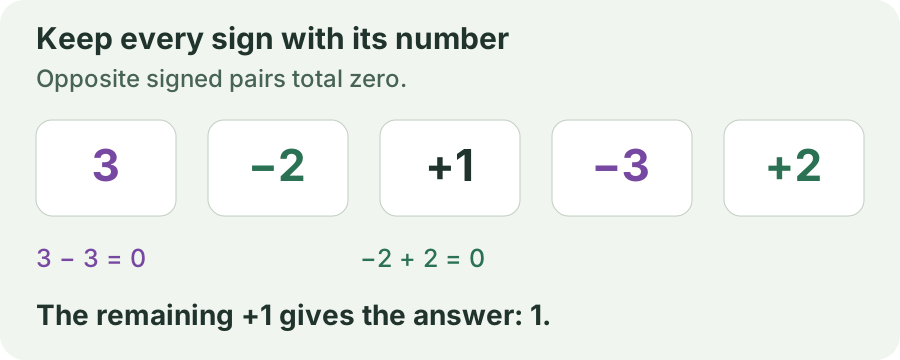
When the same number appears once positively and once negatively, the pair adds to zero. You may remove that pair mentally without changing the total, provided you keep each sign attached to its number.
Try 3 − 2 + 1 − 3 + 2. Positive 3 and negative 3 cancel. Negative 2 and positive 2 cancel. The remaining positive 1 is the answer. You do not have to calculate every intermediate total if those pairs are immediately clear.
Cancellation is useful, not compulsory. Searching the whole line for a pair can take longer than simply adding it. Choose the method that lets you explain the answer without rereading the expression several times.
Keep a running total when the pairs do not stand out
For −2 + 3 − 1 + 2, go from left to right: negative two, then one, then zero, then two. The final answer is 2. Each step replaces the previous total, so you only need to hold one number in mind.
The earlier example 2 − 1 − 2 + 3 also finishes at 2: start at two, go to one, then negative one, then two. If working below zero makes you hesitate, practise these short transitions before trying to increase your record.
Use the answer range as a final check. A total of zero, four or negative one cannot be the answer to a dealt question. It signals that you should recheck a sign or an addition. It does not reveal which of the three buttons is correct, and you should not spend the entire timer repeatedly changing guesses.
Know what changes as the round progresses
The schedule depends on the number of the question shown, rather than only on your correct-answer score. These are the actual stages in our game:
| Question shown | Numbers in the sum | Time shown |
|---|---|---|
| 1–5 | 2 | 10 seconds |
| 6–15 | 3 | 9 seconds |
| 16–25 | 4 | 7 seconds |
| 26–35 | 5 | 5 seconds |
| 36–50 | 4 or 5 | 5 seconds |
| 51 onward | 4 or 5 | 4 seconds |
For example, skipping question 5 brings question 6 with its three-number sum and shorter timer. A skip does not freeze the stage. This is why spending all your skips on the opening questions can make the later part feel unexpectedly difficult.
Our server times and checks answers. Aim to answer before the visible bar ends rather than relying on network tolerance. Once a question has been replaced, its answer is no longer the answer to the new question on screen.
Use a skip for a specific reason
A standard round begins with one skip. The optional skip-pack offer gives a round four skips in total. A skipped question does not add a point; it replaces the question and the round continues.
Use it when you have lost track of a sign, have been interrupted, or can see that you will not finish the current calculation in time. Saving a skip forever is not useful if the round ends with it unused, but spending one merely because a sum looks unfamiliar avoids practising exactly the skill you need.
One wrong answer or timeout normally ends your attempt. The game can offer one continue per round while its continue window is open. A continue brings a fresh question; it does not turn the failed answer into a correct point.
What the studio-message buttons mean
The current optional reward screen is a timed text message from the studio. It is not a video or a paid advertisement. Staying until its countdown completes can unlock the stated benefit, subject to the game's limits. Closing early gives no reward.
Math 123 normally allows three rounds in a rolling hour, with one additional round available through the extra-round offer. The displayed availability comes from the server; a new calendar hour does not necessarily reset a limit based on your recent starts. The next available time is shown when the normal rounds are used.
A practical way to practise
First play a round concentrating on reading signs correctly, with no attempt to tap at maximum speed. For each expression, choose one of two methods: cancel a pair you already see, or keep a running total. Avoid switching methods halfway through unless you have a clear reason.
After a mistake, identify the step that failed: a missed leading minus, a lost intermediate total, or an answer sent after the bar ended. Work through an example of that kind before starting again. Your score counts correct answers, and the monthly leaderboard records a member's best result. A cleaner calculation is a better next objective than an unexplained lucky guess.
When you are ready, play Math 123 and use the first five questions to establish a steady rhythm before the longer sums arrive.
