
What a word ladder is
You get a start word and a target word of the same length. Change one letter at a time, keeping the others where they are, until you reach the target. Every word on the way has to be a real word.
COLD → CORD → WORD → WARD → WARM
That is four changes, and four is the least this pair needs: COLD and WARM have no letter in the same place, so each of the four letters has to change at least once.
The puzzle is old. Lewis Carroll said he invented it at Christmas 1877, and he published it as Doublets in the magazine Vanity Fair from March 1879, with challenges such as turning HEAD into TAIL (HEAD, HEAL, TEAL, TELL, TALL, TAIL). The idea has not changed since; only the clock is new.
Follow a complete four-change example
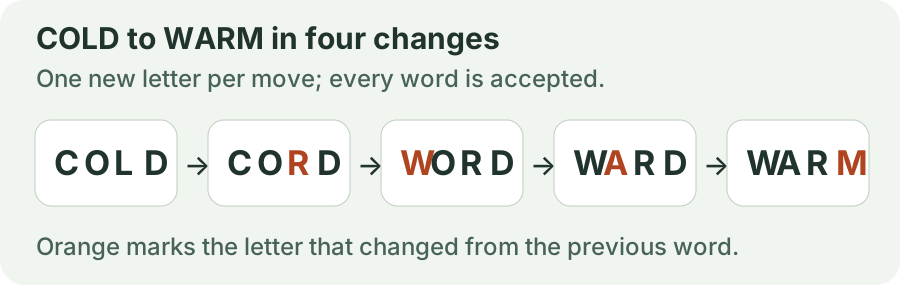
| Move | Word | What changed | Why it helps |
|---|---|---|---|
| Start | COLD | Nothing yet | Compare each letter with WARM. All four positions differ. |
| 1 | CORD | Third letter: L → R | R is now in its target position and CORD is an accepted word. |
| 2 | WORD | First letter: C → W | W joins the R in the correct position. |
| 3 | WARD | Second letter: O → A | Only the final letter is now different from WARM. |
| 4 | WARM | Fourth letter: D → M | The target is reached. |
Four differing positions prove that fewer than four one-letter moves cannot solve this pair. This accepted four-move path reaches that lower bound, so it is shortest. That does not mean every ladder can be solved by changing each differing letter only once: some need a detour.
Try predicting the next word before reading each table row. If an imagined move changes two letters, it cannot be one step. If it produces a spelling you are unsure of, choose a familiar alternative rather than assuming the game accepts every dictionary entry.
1. Start from what the words share
Before you change anything, compare the start and the target letter by letter. A letter that is already right in both words can often stay put for the whole ladder, and it tells you which positions are the real work.
In COLD → WARM nothing is shared, so every letter must move. In LOVE → LIVE only one letter differs, and the ladder is a single step. Most puzzles sit in between: knowing which letters to leave alone halves the search.
2. Change the vowel first
Vowels have the most real words around them. BALL becomes BELL, BILL or BULL; HOT becomes HAT, HIT or HUT. When you cannot see a way forward, try every vowel in the vowel position: it is the move most likely to give you a real word that brings you closer.
3. Use the common endings
Some endings are crowded with words: -ATE (DATE, GATE, LATE, MATE, RATE), -ING (KING, RING, SING, WING), -OLD (BOLD, COLD, FOLD, GOLD, HOLD, TOLD). If your ladder can pass through one of these families, you can change the first letter almost freely while the ending holds steady — and the first letter is often the hardest one to move.
4. When a letter is blocked, change a different one
Sometimes the letter you need to change cannot change yet: every word you can make from it is not a real word. That is when solvers take a step that looks sideways. Change another letter first, and the blocked one often frees up.
In COLD → WARM, the C cannot become W straight away — WOLD is not in Word Steps' word list — so the ladder changes the L first (CORD), and then the C (WORD). The order of the changes matters as much as the changes themselves.
5. Work backwards from the target
If the start word gives you nothing, look at the target instead. Which real words are one step from WARM? WARD, WARN, WART, WORM, FARM, HARM. Any of them is a stepping stone, and finding a word that is one step from both your current word and the target is the fastest way to close the last gap.
6. Expect a letter to change twice
Count the letters that differ between the start and the target: that is the fewest steps any ladder can take. Often the real ladder is longer, because one letter has to go somewhere else first and come back. Carroll's HEAD → TAIL has four letters that differ but takes five steps: the third letter goes from A to L and then to I, because no word lets it go straight there.
So when the count says four and you cannot find four, do not assume you have missed something. Look for a detour through a letter that neither word has.
7. Do not chase the shortest path
In Word Steps any path to the target counts. Each ladder shows how many steps its shortest way takes, so you know what is possible, but your score is your time and nothing else. A slightly longer ladder found quickly beats a perfect one found slowly.
Use the controls without losing your place
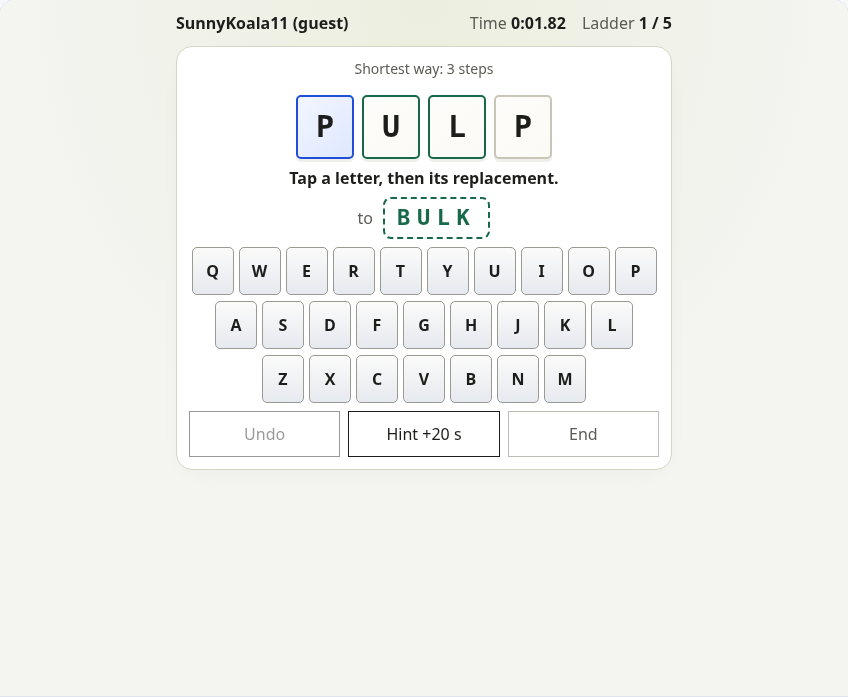
The highlighted letter is the one the next key will replace. Check that selection before typing: a good idea can still be refused if you edit the wrong position. An accepted word joins the ladder. If you need to return to the previous word, use Undo; if you want a demonstrated next step, Hint moves along a shortest route from your current word and adds twenty seconds.
A refused word is feedback about that move, not a lost life. It may be outside the accepted list, change more than one letter, or repeat a word already on this ladder. Recheck the selected position, keep the letters that were already useful and try another neighbouring word. You are scored on total time rather than on finding one prescribed answer.
How Word Steps works
- A round is five ladders of four-letter words, with shortest-path lengths of three, four, four, five and six changes.
- Tap a letter to choose it, then tap or type the new letter. A real word joins your ladder; a word that is not accepted is refused, and nothing is lost. Undo steps back one word.
- Words come from everyday English four-letter words in the SCOWL word lists, without proper names and without offensive words.
- Hint shows the next word on a shortest way from where you are, and adds twenty seconds to your time. That is usually less than a stuck ladder costs.
- Your time for all five ladders is measured by our server. The leaderboard is monthly and resets on the 1st of every month at 00:00 UTC.
Play Word Steps as a guest straight away, or sign in to put your time on the board.
