
First check whether a move is legal
Egg Flip is our Reversi-style board game. You play green and move first; the computer plays orange. A move must place an egg on an empty square and trap at least one uninterrupted line of orange eggs between the new egg and an existing green egg. The line can run horizontally, vertically or diagonally. Every trapped line flips, not just the first one you notice.
An empty square beside an orange egg is not automatically playable. There must be a green egg at the other end, with no gap between them. Start by looking at the legal squares the game offers, then compare what happens after each placement. The number of eggs you flip now is only the beginning of that comparison.
Why a corner is different
A corner egg cannot be trapped between two opposing eggs: there is no square beyond the corner from which to complete the line. Once you own that square, it stays yours. This is why an early lead in egg count can be less useful than access to a corner.
The squares beside an empty corner need more care. B2, diagonally beside A1, is a common trap. Placing there can provide the green egg that Orange needs to complete a diagonal capture into A1. That does not make B2 illegal, and it is not always a losing move. It means you should inspect the reply before taking it.
A position to read, not just a rule to memorise
The diagram is a legal position reached from Egg Flip's normal opening. Green moves next. Columns run A to H from left to right, and rows 1 to 8 from top to bottom. B2 and H3 are two legal choices; they are not the only moves available.
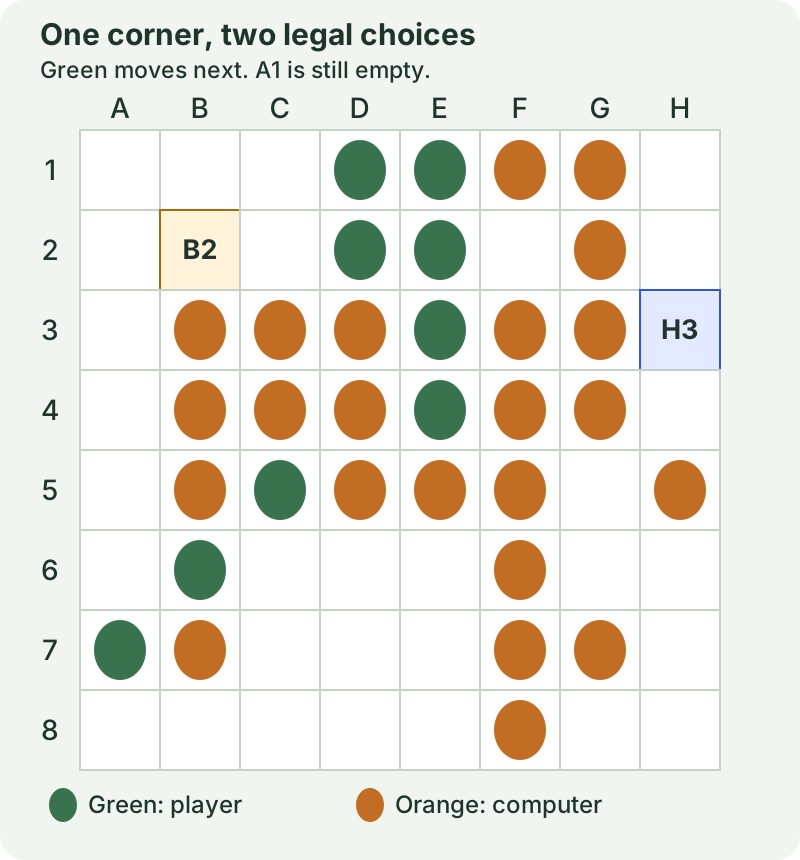
Option one: B2 flips three. Look down column B. B3, B4 and B5 are orange, with a green egg on B6 closing the line. A green egg on B2 flips those three orange eggs. The immediate result looks attractive: you have added an egg and changed three more to your colour.
Now read the diagonal from A1. After B2, that diagonal starts with an empty A1, a green B2 and an orange C3. Orange can play A1, trap B2 against C3 and keep the corner. The three-egg flip has supplied a dangerous reply.
Option two: H3 flips two. Read left from H3: G3 and F3 are orange, followed by a green E3. H3 flips those two eggs. In this position, that move does not make A1 legal for Orange. It avoids the specific immediate corner offer created by B2.
We are not claiming H3 forces a win or is the best move in every search. The example proves a narrower, useful point: the larger immediate flip can offer a corner that a smaller flip avoids. Our tests replay the position and check both consequences against the actual rules.
Count the replies as well as the eggs
Having several legal moves gives you choices. Having only one can force you to open a corner or a weak edge. When two placements look similar, inspect the computer's likely legal replies and your own next opportunities. A move that leaves a flexible position can be more useful than one that makes the board look greener for a moment.
Do not turn this into another absolute rule. Sometimes a large flip is the right move, especially near the end when the remaining moves and final count matter directly. Likewise, an edge is not automatically secure. An egg beside an empty corner can still be trapped along that edge. Corners are special because the board ends there; other squares need to be read in context.
A pass is not the end of the game
If a side has no legal move, it passes. The game ends when neither side can move, which can happen before all 64 squares are filled. In Egg Flip, the server handles those passes, so the computer may make more than one reply when Green cannot move.
Near the end, count remaining empty squares and legal captures. A position with fewer green eggs can still finish ahead if the last available moves flip the right lines. Do not resign solely because you are behind in the middle of the game.
What counts on our leaderboard
Egg Flip's ranked level is Medium. A win scores the final difference between green and orange eggs: a 35–29 finish is a six-point win. A loss, draw or resignation does not produce a winning score. The monthly board is about your best scored result, not a running total of every egg you have ever flipped.
For a practical routine, check legal moves, inspect empty corners, read the immediate reply, and only then compare flip counts. Play a round of Egg Flip, pause before a tempting corner-adjacent move, and try to explain what the computer could do next. That explanation is a more useful habit than choosing the greenest-looking board.
