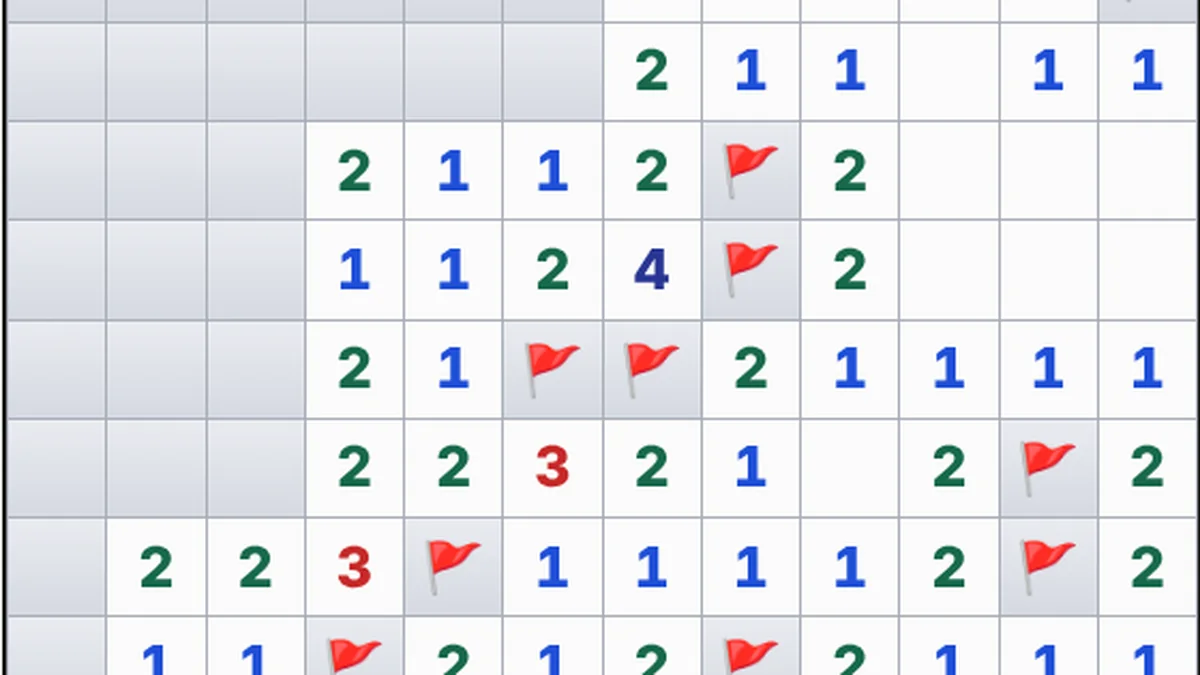
What a number tells you
A number on an opened square counts the mines in the squares that touch it: the four beside it and the four on its diagonals. A 1 in open ground has eight neighbours and one mine among them; a 1 against a wall has only five neighbours, and a 1 in a corner only three. The fewer covered squares a number touches, the more it gives away.
Two simple rules do most of the work:
- When a number touches exactly as many covered squares as it shows, all of them are mines. A 2 with only two covered neighbours has a mine in each.
- When a number already touches as many flags as it shows, every other square around it is safe. A 1 next to a flag needs nothing more.
Everything below is these two rules, applied to two or three numbers at once.
How to read the diagrams
Each diagram shows a strip of the board: the bottom row is opened squares, the top row the covered squares beyond them. Squares further away are either opened or do not matter.
1,2— an opened number;.— an opened square whose number does not matter here*— certainly a mine: flag ito— certainly safe: open ita— exactly one of the squares markedais a mine, you cannot yet tell which|— the wall at the edge of the board
The 1-1 pattern along a wall
Picture a straight edge of opened squares, with covered squares beyond it, and two 1s side by side on that edge. The first 1 touches three covered squares; the second touches the same three, shifted along by one.
If the first 1 sits at the end of the row — against a wall or a corner — it only touches two covered squares, and the mine must be in one of them. Both of those squares also touch the second 1. That second 1 has now used up its one mine, so the covered square it touches beyond the first two is safe. Open it.
| a a o
| 1 1 .
This is the most common deduction in the game. Whenever you see a 1 at the end of an edge, look at the number next to it.
The 1-2 pattern
Now take a 1 and a 2 side by side on an edge. The 2 touches three covered squares; the 1 touches two of those same three.
The 1 can account for at most one mine among the squares the two numbers share. The 2 needs two mines, so its other one must be in the square only the 2 touches. Flag it. If the 1 touches a square the 2 does not, that square is safe, because the 1's mine is already among the shared ones.
o a a *
. 1 2 .
Read it as: the bigger number needs mines the smaller one cannot give it.
1-2-1 and 1-2-2-1
Along a straight edge, the sequence 1-2-1 always has the same answer: the mines are under the two 1s, and the square under the 2 is safe. Work it through with the 1-2 rule from each end and both 1s point to the same place. The squares just beyond the two 1s are safe too, because each 1 already has its mine.
o * o * o
. 1 2 1 .
The sequence 1-2-2-1 is its longer cousin: the mines are under the two 2s, and the squares under the 1s are safe.
o o * * o o
. 1 2 2 1 .
These two are worth memorising as shapes. Spotting them takes a glance, and on a 12×12 board they turn up again and again.
2-1-2
The 1 in the middle allows only one mine among the three squares it touches. Each 2 needs two mines, and at most one of them can be shared with the 1 — so each 2 has a mine in the square at its far end. Both 2s still need their second mine from the squares they share with the 1, and since the 1 allows only one mine across all three, it must be the square both 2s share: the one under the 1. So the mines are at the two ends and under the 1, and the squares under the 2s are safe.
* o * o *
. 2 1 2 .
Subtract the flags you already have
Most numbers on a real board do not sit in a clean row. The trick that turns a messy edge into one of the patterns above is to subtract the flags a number already touches. A 3 that touches one flag behaves exactly like a 2 for the squares still covered around it; a 2 that touches one flag is a 1.
Do that in your head along an edge: a 2-3-2 whose numbers each touch one flag is a 1-2-1 in disguise. Every pattern in this guide works on the reduced numbers.
Common mistakes
- Forcing a pattern that is not there. The diagrams only hold when the covered squares are all on one side of the row. If there are covered squares on the other side too, or the row bends, work the numbers out from the rules instead.
- Forgetting the squares at the ends. In a 1-2-1 the squares just beyond the 1s are safe; players who only open the square under the 2 leave easy squares behind.
- Flagging and moving on. A flag is worth most when you use it straight away: subtract it, or chord on the numbers around it.
Chording: opening many squares at once
When a number already touches as many flags as it shows, tap it. Mines opens every other covered square around it in one move. This is called chording, and it is the biggest single saving of time in the game: three taps become one.
Chording trusts your flags. If a flag is in the wrong place, chording around it opens a mine. Flags are notes you keep for yourself, and a wrong one only hurts when you chord next to it — so flag with care, and chord where you are sure.
Counting at the end
Near the end of a board the mine counter becomes a clue of its own. Mines shows how many mines are still unflagged; the solver that checks every board knows that total too, and so should you.
Say two mines are left and the covered squares form two separate pockets. If one pocket must hold at least one mine and the other must hold at least one, each holds exactly one — and any third pocket is entirely safe. Counting like this settles the last few squares that the numbers alone leave open.
Why you never have to guess in Mines
In most versions of the game, a board sometimes leaves two squares that no number can tell apart: a coin toss. Mines does not deal those boards. Each board opens with a safe area already uncovered, away from the edge so it has room to spread, and before you see it a solver plays it through using only what the numbers and the mine total say. If the solver would need a guess, the board is thrown away and another one dealt.
So when you are stuck, the answer is always on the board. Go back over the edges, look at numbers in pairs, and count what is left. A fast time in Mines is never a lucky one.
The three levels
- Easy: 9×9 with 10 mines. Good for learning the patterns.
- Medium: 12×12 with 24 mines. The ranked level, on a monthly leaderboard that resets on the 1st of every month at 00:00 UTC.
- Hard: 16×16 with 40 mines. Longer chains of deduction, and more counting at the end.
Ready to try them? Play Mines — no account needed, and your time is measured by our server from the moment the opening area is shown.