The rule, and what it really means
A Sudoku grid is nine rows, nine columns and nine 3×3 boxes. Each row, column and box must hold the digits 1 to 9 exactly once. That is the whole rule.
It helps to notice that there is no arithmetic in it. The digits could be nine colours or nine letters. What you are really tracking is where each digit can still go — and every technique below is a way of narrowing that down.
Scan one digit at a time
The fastest way into a new puzzle is to pick a digit and follow it across the whole grid. Take the 7s. Every 7 already placed rules out its row, its column and its box for all other 7s. Look at each box that has no 7 yet and cross off, in your head, the rows and columns already used by 7s elsewhere. Often only one cell is left in that box. That is where the 7 goes.
Here is the top band of a grid — three boxes side by side — with . for an empty cell:
7 . . | . . . | . . .
. . . | . 7 . | . . .
. . . | . . . | 4 . 9
The 7 in the first row rules that row out for the right-hand box; the 7 in the second row rules out the second. So the right-hand box's 7 is in its third row — and two of those three cells are already taken by the 4 and the 9. The 7 goes in the middle cell of that row, the one between the 4 and the 9.
This is called cross-hatching, and it is where nearly every solve starts. Go through 1 to 9 this way, then go round again: each digit you place opens up new spots for the others.
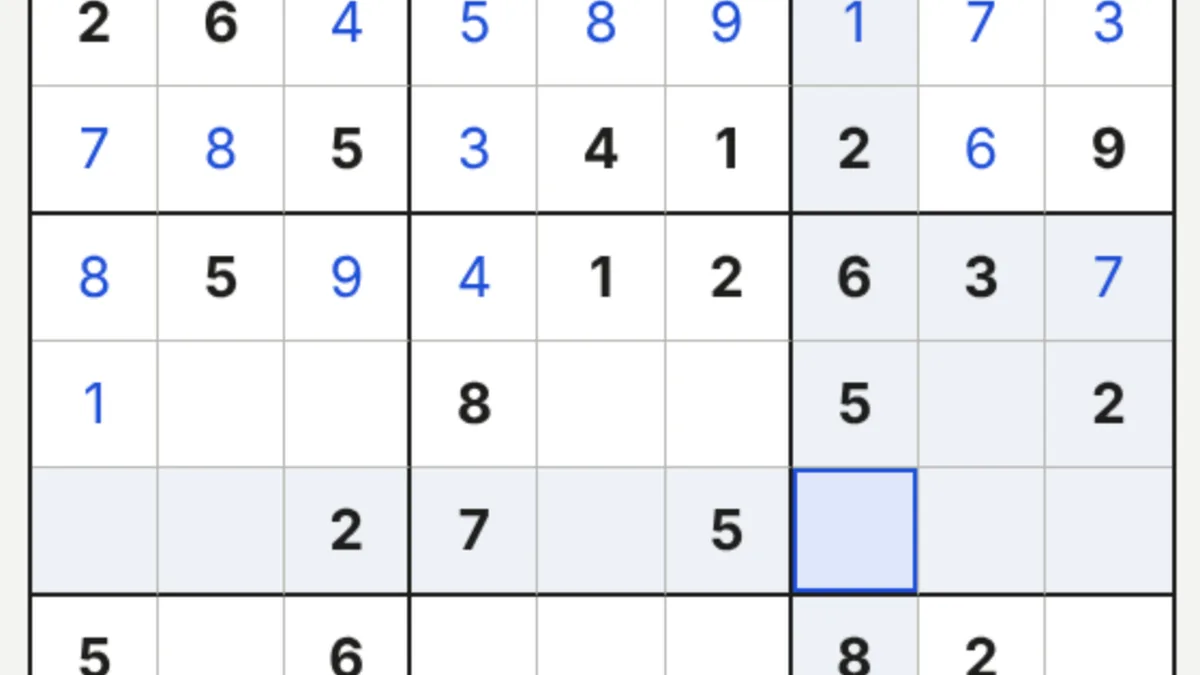
In our Sudoku, tapping a filled cell highlights every matching digit on the board, which makes the rows and columns a digit has already used stand out.
Hidden singles: one place for a digit
Cross-hatching finds hidden singles: a digit that has only one possible cell within a row, a column or a box. The cell might look as if it could hold several digits — but if it is the only place in its box where a 4 can go, it is a 4.
This is the technique to keep coming back to. When you are stuck, go round the digits once more; a single placement elsewhere has often just made a new hidden single.
Naked singles: one digit for a place
The other way round: look at a single empty cell and list the digits its row, column and box have not used yet. If only one digit is left, that is the answer. This is a naked single.
Naked singles are easiest to see in cells whose row, column and box are already crowded. When you are not sure yet, pencil the possible digits in: in our Sudoku, switch Notes on (or press N) and tap the digits. Notes never count as mistakes, and when you place a number it disappears from the notes in its row, column and box. On a sparse board they are rare, which is why scanning by digit usually comes first.
Pairs: ruling digits out
When singles run dry, start ruling digits out.
Naked pairs. If two cells in the same box (or row, or column) can each only hold the same two digits — say 3 and 8 — then those two cells will take the 3 and the 8 between them. No other cell in that box can hold a 3 or an 8. Cross them off, and a single often appears.
Hidden pairs. The mirror image: if two digits can only go in the same two cells of a box, those two cells hold those two digits and nothing else. Any other digit you were considering for them can be dropped.
Pointing: when a box points along a line
Sometimes all the possible cells for a digit inside one box sit in a single row. The digit is certainly in that row, inside that box — so it cannot appear anywhere else in that row, in the other two boxes it passes through. The box points along the row and clears it.
The reverse works too. If, in a row, a digit can only go in cells that fall inside one box, then that box's other cells cannot hold it. Together these are often called pointing and box-line reduction, and they crack many puzzles that pairs alone do not.
Beyond pairs: the X-Wing
Some hard puzzles need one more idea, and the X-Wing is the one most worth knowing. Pick a digit and look at two rows. If, in each of those rows, the digit can only go in the same two columns, then those four cells form a rectangle and the digit takes two opposite corners of it — either way round, one in each of the two columns.
That settles both columns: the digit cannot go anywhere else in either of them, so cross it off every other cell of those columns. The same works with two columns and two rows swapped. It looks rare, but once you know the shape you start to see it on the hardest boards.
A solving routine
- Scan every digit from 1 to 9 for hidden singles.
- Look at crowded rows, columns and boxes for naked singles.
- Repeat 1 and 2 until nothing new appears.
- Look for pairs and pointing to rule digits out, then go back to step 1.
- Still stuck on a hard board? Look for an X-Wing in the digit that has the fewest places left.
On Easy boards, steps 1 and 2 are usually enough. Medium needs them done well and quickly. Hard boards start with fewer digits — as few as 26, against 32 or so on Medium and about 40 on Easy — and that is where pairs and pointing start to matter.
Why you never need to guess
Every board in our Sudoku is generated fresh and checked to have exactly one solution. A puzzle with a single solution can always be reached by a chain of deductions like the ones above, so there is never a point where a guess is the only way forward.
That matters, because a wrong digit counts as a mistake and three mistakes end the board. Place a digit only when you can say why it must go there.
Short on time? Try Mini Sudoku
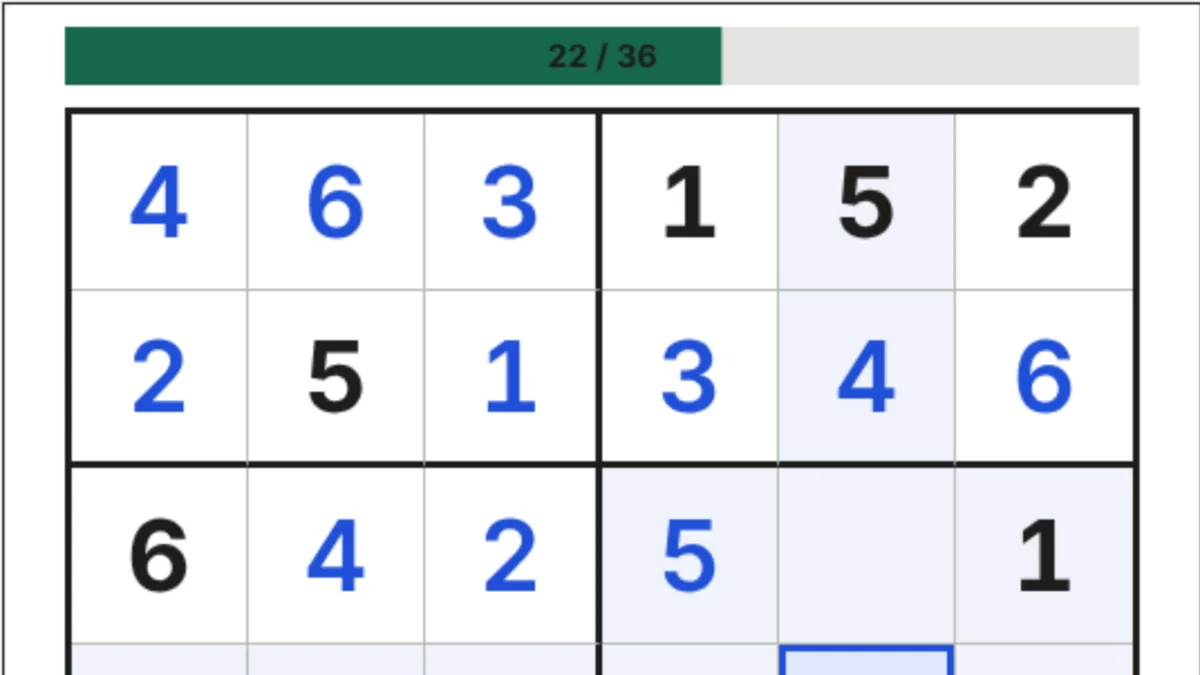
If a full grid is more than you have time for, Mini Sudoku uses the same rule on a smaller grid, and every technique here works on it. When you want the full puzzle, play Sudoku: Medium is the ranked level, on a leaderboard that resets on the 1st of every month.